










Patricia Abbatoy
Riverside ReviewCouncil President James Pitts Speaks Candidly about:
 |
His Personal Life |
|
The Commish |
|
The Peace Bridge |
|
The Costly New City Charter |
|
The Mayor's Shadow Government |
February 2000: Many residents of the North District have an image of James Pitts as the man with the bow tie, and a man who, admittedly, likes a good fight. Few in our community are familiar with the personal side of the Council President; his likes and dislikes, daily life and political opinions. That's why the
REVIEW chose to go "Behind the Bow Tie."
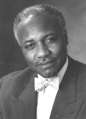 Mr. Pitts is an extremely knowledgeable, cordial and hard-working man. During the interview, he laughed and smiled readily, and made me feel comfortable. He is a moving speaker who is also quick with well-timed, surly quips.
Is Police Commissioner Rocco Diina doing a good job, I asked. "I think it depends on what day it is," Pitts answered. There has been a bit of friction recently since Pitts reportedly summoned the commissioner to council chambers on thirty minutes notice.
At last October's VOICE-Buffalo meeting, Pitts was asked about the Riverwalk and responded similarly: "If I were mayor, it would have been done already."
Regardless of his reputation or personality, Mr. Pitts has a long history of community service, which he began as a teen and young adult working with the Urban League and BUILD organizations. He began elected office in 1978 as Ellicott District Council Member.
He is "very hands-on" and makes every effort to be accessible to his constituents. As an example, while many Council Members and department heads have voice mail, the Council President replied, "I won't allow it in my office."
"Primarily, people pay their taxes (and) they want to get somebody; they want to talk to somebody," he said. Accordingly, he answers his phone calls and schedules his own appointments.
So, what is a typical day for the Council President? "A typical day is getting up very early and getting my kids off to school and getting my wife off to work," he said. James Pitts and his wife Mary have three boys, Jumane, Justin and Jordan.
"I usually work out every morning-early in the morning-and I come here and I usually have a lot of phone calls and letters and meetings," he said.
Pitts says he doesn't leave City Hall until 6:30-7:00pm and at least two or three times a week doesn't get home until 9pm. He also has a number of speaking engagements during African American History Month, which he describes as a "good thing" although he feels it has become "almost perfunctory."
In his opinion, many of the activities surrounding African American History Month deal with the same issues and don't "probe more deeply into the issues of race relations or different aspects of African American history."
There have been complaints by some that Buffalo is a segregated community. Pitts sees it as more of a parochial thing, that there are "very strong communities and neighborhoods that are identified ethnically, and I think that's fairly typical in America. In my view, that's one of the most positive attributes."
As a kid living on Grape Street one of the "most exciting" things he would do on a Saturday morning was go to the library or museum, where he was exposed to different cultures, something he sees as key to Buffalo's survival.
"If we don't reach beyond, above and over these barriers and obstacles - real or imagined - and realize that Buffalo's future is developing cross culturally, we're not going to make it," he said.
During the interview, Mr. Pitts spoke on a number of issues.
Regarding the Peace Bridge, Pitts is a supporter of the Signature Span over the Twin Span design. He feels the Signature Span will "provide an opportunity to build a symbol, similar to what other cities have, like the one in St. Louis and the Golden Gate Bridge in San Francisco . . . It gives us a chance to do something we would be proud of," he stated.
When I asked what he would do if the consultants to the Steering Committee of the Public Consensus Review Panel (PCRP) recommend the Twin Span and the PCRP ratifies this decision, Pitts responded: "I can't answer that. I have to be neutral on that at this particular point." Also, he'd be "very disappointed" if the PCRP decides on the Twin Span.
We then discussed economic issues.
During his inauguration speech two months ago, Pitts stressed the importance of building the city up from the bottom to the top.
"Sometimes we emphasize the things that seem to be most important when it comes to economic development," he explained. "A lot of people feel that in order for downtown to be successful" we have to have "big bucks business or chain stores." He sees it differently.
"It would be nice to have a restaurant like Chef's downtown or John's Italian Village," he told me. "That's how we're going to make downtown flourish. In my view, we have a lot of talented, existing business people and entrepreneurs. We should take some of the abandoned buildings downtown and try to entice some of these entrepreneurs and bring activity into the area."
If you were one of those people who failed to vote in the last general election, you missed an opportunity to have some input in the way the City of Buffalo is governed. I'm referring to the new City Charter, which according to Pitts, was approved with "a very small turnout of the electorate."
Pitts explained that the revised Charter is going to cost the city a lot more money than originally anticipated (the exact amount won't be known until the mayor gives the council his budget, but it is expected to be in the millions.) This is because the city has to generate new departments.
"You have a new Office of Strategic Planning, new Division of Environmental Affairs, and even though your breaking down the existing Office of Community Development, you're going to have to hire people to fill these positions," he said.
"There is also a new Department of Human Resources and you also have to create in this a mega Department of Public Works, which is already the largest department in the city." The Charter expands its powers and duties. "You're creating a monster here," he added. He believes the Common Council will move to change some of the provisions in the Charter.
Even so, Pitts supported the development of the Charter although he feels that "some of things put in there were unnecessary" and some of the people who served on the commission "were there for political purposes; trying to get rid of me or trying to take power away from the council and give it to the mayor." He said that under Buffalo's Charter "we have a strong mayor government when it comes to the executive branch (mayor) and legislative branch (common council)." In sum, the mayor has the last word. He can veto and override the Common Council. "We see that happening a lot with economic development issues," Pitts explained.
He elaborated: "The Buffalo Renewal Agency, Buffalo Economic Renaissance Corporation, Buffalo Neighborhood Revitalization Corporation and Development Downtown Incorporated are all public and private corporations that are headed by the mayor. Monies are allocated through our federal programs to develop economic development projects such as the Inner Harbor or housing rehabilitation programs. The mayor uses these agencies to develop these initiatives."
"Many of these programs are not brought before the council so they can be reviewed or monitored," In fact, he says, often the council will first learn of a program from the media.
Pitts also advocated taking the alleged "shadow governments" (which he described as agencies such as the Buffalo Renewal Agency and the BERC, among others) and "putting them under the Charter so that the mayor wouldn't have the ability to just take dollars from the federal monies we receive without having them scrutinized" by the council. The Charter Revision Committee refused to include this.
Pitts also discussed the city's purchase of land for the new Theatre District police station on Main Street and Tupper. The city later learned that there is a gas line beneath the land that needs to be removed. This will cost the city about $100,000. Then there is the parking lot the city purchased on Forest Avenue at Elmwood. "These decisions are being made without the council's involvement," Pitts complained.
But Pitts thinks that on the whole the City Charter tries to develop more efficiency when it comes to some of the operations of city government.
He went before the Charter Revision Committee and advocated for the creation of the Department of Strategic Planning, an environmental department, as well as an Office of Telecommunications so the city could "negotiate contracts with telecommunications companies." These items were included in the Charter.
He indicated that once the council receives the mayor's budget, there might be changes to the Charter to get rid of any inefficiencies. Although any issues that change the power relationship between the mayor, council or comptroller must go to a referendum.
Despite the costs of implementing the new charter, Pitts argues that there are positives aspects to it as well.
For example, the Citizens Commission on Rights and Community Relations. There is a provision which stipulates that any time a citizens files a complaint with the mayor, council or department head, the complaint must be resolved within three days. However, in complex cases citizens will be notified that their complaint was received and is being investigated.
The commission will also handle complaints regarding police misconduct and abuse. After several Buffalo Police officers were suspended in 1998 for allegedly sending or receiving e-mails containing racial slurs there was much public debate on the need for a citizens review panel.
Pitts is "very optimistic" about the commission's ability to address these matters.
The Buffalo Police Benevolent Association newsletter "The Blue Line" published a scathing front page editorial which accused Commissioner Diina of destroying morale in the police department.
"I think that on the whole he's been a good commissioner. I do know there is an issue of bad morale within the department but I supported Rocco and we all have our faults and hopefully he'll get better," Pitts responded.
Could it be that Commissioner Diina, who was appointed less than two years ago and is still new to the job, hasn't quite found the right management style to instill discipline and yet build and maintain morale? "That's true, I hadn't thought about that, in terms of his management. I think that may be his weakness, because I think he gets a little over sensitive about stuff. But I think he's a good commissioner," he said.
Finally, I asked Mr. Pitts if he has any political aspirations beyond Council President. There are rumors circulating that he might make a run for mayor. "I think I may run for reelection. I'm content being Council President," he concluded with a huge smile on his face.
