








Fresh Water Not So Fresh
Rob Gerke, Jr.
Photos by Richard Mack
Riverside Review
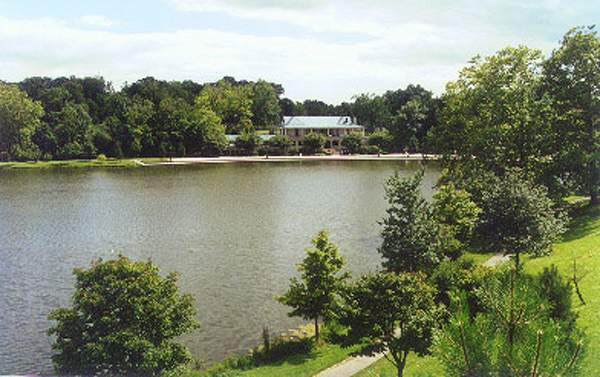
Beautiful Mirror Lake with the Historical Society and Japanese Gardens in the background. (Click to Enlarge)
August 2000: According to a new report released recently by the Citizens’ Environmental Coalition (CEC), pollution in Western New York remains a serious problem.
The CEC is a "statewide grassroots organization" which works to educate people about environmental problems.
Much of the environmental contamination highlighted in the report is due to the high number of local hazardous waste sites and the pollution of the Great Lakes, which, in turn, infects linked rivers, streams and other bodies of freshwater.
The CEC report comes at the same time the International Joint Commission has criticized the U.S. and Canadian governments for failing to completely honor a 22-year-old agreement to clean up the Great Lakes.
In the report on lake water quality, the commission said the governments "have not committed adequate funding or taken the decisive actions required to restore and protect the Great Lakes."
Because of this freshwater contamination, fish consumption advisories were issued. The CEC report lists all of the bodies of water in the state, along with advice on how much you can safely consume.
The Niagara River, a very popular spot for fishing locally, contains a high amount of PCBs (polychlorinated biphenyls), which makes eating the fish caught there dangerous. These chemicals, although reportedly no longer in use today, were used for electrical transformers and hydraulic oil from the 1960’s through the 80’s. Since they were used so often, they still remain in our environment.
Hoyt Lake, located in Delaware Park, is also contaminated with PCBs - not as badly as the Niagara River, however. The CEC report recommends that no carp caught in the Niagara River be eaten. From Hoyt Lake, the report says it is safe to eat one per month.
The fish consumption advisory pertains to males over the age of 15 and women over child-bearing age. Anyone under 16 and women who are still able to have children should not eat any fish caught from these waters, according to the report.
Lake Erie, however, isn’t quite as bad as other lakes, according to Donald Brown of the New York State Dept. of Health. He says Lake Erie is much cleaner than Lake Ontario.
The advisory for Lake Erie is to not eat more than one meal per week of Chinook salmon, turbot, freshwater drum, lake whitefish, rock bass and yellow perch. Any other fish in the lake - eat no more than one meal per month.
Women and children fit into this category as well. This is unlike the other bodies of water in the area where women and children are advised to eat none at all.
WHAT TOXINS LURK in the sediments on the bottom of peaceful Hoyt Lake? Only the fish know and they ain’t talkin’. (Click to Enlarge)
Recent research shows that the health hazards posed by consuming their fish may not affect a person immediately. Even small amounts of pollutants are stored in the fatty cells of fish and humans, and can pose serious health risks. Many of these effects are transgenerational, which means it affects our children.
Some of these effects include lower IQ scores, poor memory, attention deficit disorder, and depressed immune systems.
It’s hard to track the side effects of these chemicals because people respond differently to chemicals. An increase in asthma and other chronic diseases was reported, and seems to be linked to these chemicals.
While the International Joint Commission report says that progress has been made, much more work needs to be done. Aside from the fish consumption advisories, drinking water taken from the lake still must be extensively treated. Also, swimming often must be prohibited and beaches closed.
Cleanup efforts are difficult because much of the pollution is not so much visible as it is rooted in the underlying sediment.
Many of the chemicals on the loose in our environment weren’t considered dangerous when in use. DDT, for example, when used as a panacea, became responsible for almost causing the extinction of many species of birds.
Where does this pollution come from? While WNY is home to several hazardous waste sites, pollution comes from other places as well. One of the largest polluters is hospital systems.
Medical waste accounts for a high percentage of toxins in the environment. Garbage burned in hospital waste incinerators produces dioxins. Dioxins are created when organic compounds are burned with chlorine. A source of chlorine is plastic, which is what many disposable medical supplies are made of.
In 1998, New York State passed regulations on the medical industry, which put requirements on medical waste incinerators. Several incinerators closed, and the rest are required to come into compliance with these regulations by this year.
Besides hospitals, there are quite a few other common sources of pollution. Underground tanks that store chemicals and tanks at gas stations begin to leak after awhile. Junk yards, which are now regulated, used to junk cars without first draining the oil and antifreeze, which in turn, leaked into the environment.
In 1978, the Great Lakes Water Quality Agreement was made between the US government and Canada, where they pledged to "restore and maintain the chemical, physical, and biological integrity of waters of the Great Lakes."
Why doesn’t the Environmental Protection Agency keep closer tabs on these large industrial polluters? Frankly, claims the report, it’s because big business has had and always will have much political power.
Even when legislation is passed regarding polluters, the laws are weakened in the political process by compromises made with well-paid industry lobbyists and large corporate campaign contributions, argues the report.
There have been some steps toward bettering the environment, however. Despite corporate meddling with legislation, laws have passed. The Clean Air Act, Compensation and Liability Act, and the Clean Water Act are just a few.
The CEC report was funded by the Charles Stewart Mott Foundation. If you’d like a copy of the CEC report, you can get one for $10 by writing to the organization at 33 Central Avenue, Albany, NY 12210.